Tirupati road safety matters more than most pilgrims realise. Every week, lakhs of devotees drive in from Karnataka, Tamil Nadu and Telangana. Many arrive before dawn, on unfamiliar highways, in vehicles somebody else chose for them.
The district has now mapped exactly where those journeys go wrong. This Tirupati road safety guide pulls together what officials found, what the ghat road demands of a driver, and what to do in the hour after a crash.
Tirupati Official is an independent daily. We hold no affiliation with Tirumala Tirupati Devasthanams (TTD), APSRTC or the district administration, and we take no bookings or payments. Use the official portals linked below for current rules and timings.
Tirupati Road Safety at a Glance
- Tirupati district officials mapped 48 accident-prone black spots in April 2026, with a 60-day deadline for corrective work.
- The Tirumala ghat road carries a 30 km/h limit, and a token system flags any driver who climbs too fast.
- Call 112 first after a crash, because that line routes an ambulance and names the nearest designated hospital.
- Accident victims can claim cashless treatment worth up to ₹1.5 lakh for seven days.
- Helping an injured stranger within the golden hour earns a ₹25,000 award, not a police summons.
Why Tirupati Road Safety Is a Corridor-Wide Problem
The corridor carries an unusual mix of traffic. Pilgrim vehicles, long-haul trucks and local commuters share the same national highways. Because pilgrim arrivals peak between 3 AM and 7 AM, the riskiest hours are also the darkest ones.
Official data confirms the pattern rather than merely suggesting it. A Ministry of Road Transport and Highways report from December 2024 counted 1,202 black spots on Andhra Pradesh national highways. Tirupati district accounted for 34 of them, while neighbouring Chittoor carried 41 and Nellore 71.
A black spot has a precise official meaning. The Ministry of Road Transport and Highways defines it as a 500-metre stretch that recorded at least five accidents and ten fatalities over three years. So these are not vague danger zones, but measured stretches with a documented toll.
What the district is doing about Tirupati road safety
Repair work has moved steadily since then. By February 2025, Andhra Pradesh had rectified 901 black spots at a cost of roughly ₹1,649 crore. Tirupati district fixed 18 of its own at about ₹52 crore, while Chittoor spent ₹158.07 crore on eight.
The district then widened its Tirupati road safety survey beyond national highways. In April 2026, District Collector Venkateswar announced 48 identified black spots and set a 60-day deadline for corrective measures.
Superintendent of Police Subba Rayudu described a twin approach of enforcement and awareness. Officers stepped up breath analyser and speed detection checks across the district. Published district road safety papers appear on the Tirupati district portal.
By late May 2026, officials reported that 20 of 43 surveyed spots had finished repairs. Eleven vehicles now patrol the national highways to catch violators and assist crash victims. Police also began restricting night parking of trucks to designated bays, since stalled heavy vehicles cause collisions after dark.
Tirumala Ghat Road Rules Every Driver Must Follow
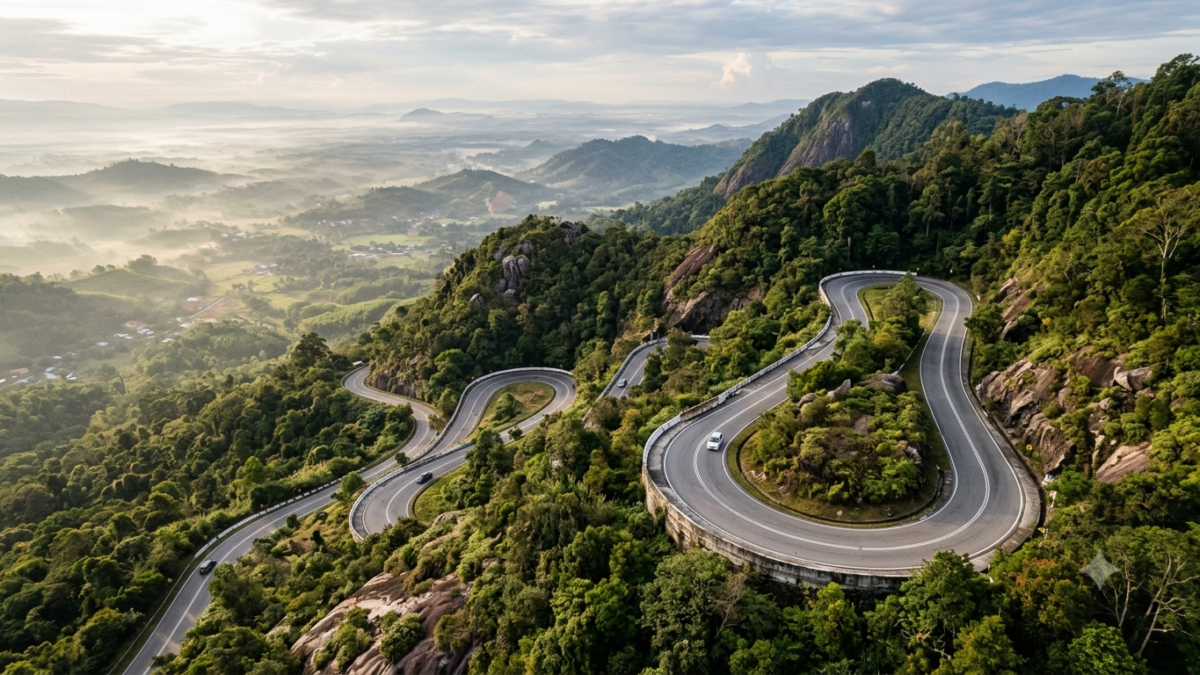
The climb to Tirumala runs through the forested Seshachalam hills on two separate one-way roads. Vehicles ascend on the newer ghat road from Alipiri and descend on the older one. Each road runs roughly 18 kilometres and carries dozens of hairpin bends.
TTD treats the ghat road as a controlled route rather than an ordinary highway, and Tirupati road safety enforcement is tightest here. Every vehicle collects a timestamped token at the Alipiri toll gate after a security check. If you reach the top faster than the minimum permitted time, the system flags you for over-speeding.
| Rule | What it means |
|---|---|
| Speed limit | 30 km/h on the ghat |
| Minimum journey time | Roughly 40 minutes; token enforced |
| Overtaking | Banned on bends and curves |
| Stopping | Only at designated points |
| Seating | Never exceed rated capacity |
| Two-wheelers | Helmet compulsory, valid licence only |
Published ghat road timings vary between sources, so treat any figure you read online as approximate. Some listings show four-wheeler access from 3 AM, others from 4 AM, with closing between 10:30 PM and midnight. Confirm the current window on the official TTD portal before you set out.
Where drivers get caught out
Private buses cannot climb to Tirumala at all. Park them at Alipiri and switch to an APSRTC service instead. Larger vehicles also face seating-capacity restrictions that catch tour operators by surprise.
Arriving late is the other common trap. If your train or flight lands near midnight, plan an overnight stay in Tirupati city rather than gambling on the gate. Vehicles turning up outside permitted hours simply wait.
Tirupati Road Safety on the Approach Highways
Most fatal crashes involving pilgrims happen well before the ghat road begins. The Chittoor-Bengaluru corridor has produced some of the worst. In September 2024, an APSRTC bus carrying devotees back from Tirumala collided with a truck at Mogali Ghat in Chittoor.
Eight people died and around thirty suffered injuries. Most of the dead were pilgrims returning to Bengaluru. Mogali Ghat already carried a reputation as a highly accident-prone stretch, and the Chittoor Collector announced ₹5 lakh relief for each bereaved family.
Winter adds a second hazard. After two women devotees died near Chandragiri in January 2025, the Tirupati SP pointed to fog as a likely factor. Low visibility on winter nights turns an ordinary early-morning drive into a genuinely risky one.
Practical timing advice
Daylight travel remains the single cheapest safety upgrade available to you. If your group insists on reaching Tirupati by dawn, break the journey overnight somewhere en route instead. A rested driver arriving at 9 AM beats an exhausted one arriving at 5 AM.
Private Van or APSRTC? A Straight Comparison
Group pilgrimages from Karnataka and Tamil Nadu often hire a private tempo or van. The economics look attractive, though the Tirupati road safety trade-off rarely gets discussed at booking time.
| Factor | Private van | APSRTC bus |
|---|---|---|
| Overloading risk | High | Low |
| Driver duty limits | Rarely enforced | Regulated |
| Vehicle inspection | Variable | Scheduled |
| Accountability after a crash | Often unclear | Corporation liable |
| Cost per head | Lower in large groups | Moderate |
Overloading deserves particular attention. A tempo rated for eight passengers frequently carries twelve on pilgrimage routes. That extra weight changes braking distance and cornering behaviour on exactly the curves where mistakes prove fatal.
APSRTC has also expanded free travel considerably. Women devotees now ride free on ghat road and Srivari Mettu services under the Stree Shakti scheme, and free buses circulate within Tirumala itself. Read our guide to free APSRTC bus travel for pilgrims before you budget for private transport.
What to Do in the First Hour After a Crash
The first sixty minutes after a serious injury determine survival more than anything that follows. Indian law now recognises this window formally as the golden hour. Three specific rights apply, and yet most pilgrims know none of them.
This is the part of Tirupati road safety that nobody rehearses. Because families freeze at a crash site, knowing the sequence in advance genuinely saves time.
Call 112, not a private ambulance
Dial 112 immediately. The operator can dispatch an ambulance through 108 and identify the nearest hospital designated under the national accident scheme. Calling a private ambulance first often sends the patient to a facility that cannot claim under the scheme.
Cashless treatment up to ₹1.5 lakh
The Cashless Treatment of Road Accident Victims Scheme took effect on 5 May 2025 under Section 162 of the Motor Vehicles Act, 1988. Any person injured by a motor vehicle on any road in India qualifies. Treatment worth up to ₹1.5 lakh runs for a maximum of seven days at a designated hospital.
The family pays nothing upfront. Hospitals raise claims against the Motor Vehicle Accident Fund instead. The Prime Minister approved a rebranded version, PM-RAHAT, in February 2026 with the same ₹1.5 lakh and seven-day coverage.
Helping a victim carries no legal risk
Many bystanders hesitate because they fear police entanglement. Good Samaritan Rules notified in September 2020 removed that exposure. The Rah-Veer scheme, announced in April 2025, goes further and awards ₹25,000 plus a certificate to anyone who gets a victim to hospital within the golden hour.
One person can claim the award up to five times a year. If several people help together, the award splits between them. So stopping to help costs you nothing and may well earn recognition.
Tirupati Road Safety for Walking Pilgrims
Thousands climb on foot each day via Alipiri Mettu or Srivari Mettu. Tirupati road safety for these pilgrims turns on the roads leading to the footpaths, since that is where the sharper danger sits.
The January 2025 case near Chandragiri illustrates it plainly. An ambulance struck seven devotees walking in the dark between Rangampeta and Mangapuram at about 4 AM. Two women died, and police registered a case under Section 106(1) of the Bharatiya Nyaya Sanhita.
The Tirupati SP advised walking devotees to keep well to the side of the road and stay alert. That advice carries real weight during winter, when fog cuts visibility sharply. Wear something reflective if you walk before sunrise, because dark clothing on an unlit shoulder is effectively invisible.
Health Notes for Elderly and At-Risk Pilgrims
Tirupati road safety also covers the climb itself, which runs to roughly 3,500 steps. Anyone with a cardiac condition, uncontrolled diabetes or mobility limits should discuss it with a doctor beforehand. Take the ghat road bus instead when in doubt.
Carry your regular medication in hand luggage rather than in the vehicle boot. Summer heat on the plains regularly pushes past 40°C, so drink water steadily through the drive. Fasting before darshan compounds dehydration, particularly for older pilgrims on a long road journey.
None of this substitutes for medical advice. If you have an existing condition, speak to your own doctor before committing to a strenuous pilgrimage.
Tirupati Road Safety Mistakes Pilgrims Keep Making
Some errors repeat across almost every serious pilgrimage crash on this corridor.
- Driving straight through the night to save a hotel bill, then attempting the ghat road on no sleep.
- Accepting a seat in an overloaded tempo because the group has already paid.
- Overtaking on a blind curve to make up time lost at a toll gate.
- Skipping seat belts in the rear rows, where nobody checks.
- Waving off a private ambulance tout at the scene, then losing the golden hour arguing about it.
- Assuming the vehicle carries valid insurance without ever asking the operator.
Ask your operator for the vehicle’s registration and insurance status before departure. A reputable one answers immediately. Hesitation tells you something worth knowing.
Tirupati Road Safety Before You Set Off
Safe travel comes down to a handful of decisions made before the engine starts. Choose daylight over darkness, official transport over an overloaded van, and a rested driver over an early arrival. Confirm ghat road timings on the TTD portal the day before you travel, since maintenance and weather do change them.
Save 112 in your phone now rather than searching for it at a crash site. Knowing that cashless treatment exists, and that helping carries no legal risk, changes what you do in the minutes that matter most. Our coverage of the TUDA master plan road network tracks the longer-term fixes now underway around the city.
Tirupati Road Safety FAQs
What is the speed limit on the Tirumala ghat road?
The ghat road carries a 30 km/h limit across its hairpin bends. TTD also enforces a minimum journey time of roughly 40 minutes through a timestamped token issued at Alipiri. Arriving at the top too quickly marks the vehicle for over-speeding.
Can I drive my own car to Tirumala at night?
Only within the permitted window, which varies by vehicle type and changes periodically. Published timings differ across sources, so confirm the current hours on the official TTD portal. Vehicles arriving outside those hours wait at the gate.
Are private buses allowed on the ghat road?
No. Private buses must park at Alipiri, and passengers switch to an APSRTC service for the climb. Smaller vehicles within rated seating capacity may proceed, subject to the usual checks.
Who pays for hospital treatment after a road accident?
Under the national cashless treatment scheme, a designated hospital treats the victim at no upfront cost. Coverage extends to ₹1.5 lakh per victim for up to seven days. The hospital claims reimbursement from the Motor Vehicle Accident Fund afterwards.
Will I face police trouble if I help an accident victim?
No. Good Samaritan Rules protect anyone who assists an injured person in good faith. The Rah-Veer scheme additionally awards ₹25,000 and a certificate for getting a victim to hospital within the golden hour.
Which route into Tirupati is most accident-prone?
Official black spot data flags the Chittoor corridor heavily, and Mogali Ghat in particular has a documented crash history. Tirupati road safety records show 34 national highway black spots in the December 2024 ministry count. Repair work continues across the district.
What compensation applies in a hit-and-run death?
Central rules provide ₹2 lakh to the immediate family where a hit-and-run accident causes death. Reporting the accident to police promptly matters, because claims depend on an official record. Consult a qualified lawyer for your specific case.
Is fog a real risk around Tirupati?
Yes, particularly on winter nights and early mornings. The Tirupati SP has publicly linked low visibility to early-morning fatalities near Chandragiri. Walking pilgrims and drivers both face raised risk between roughly midnight and sunrise in that season.