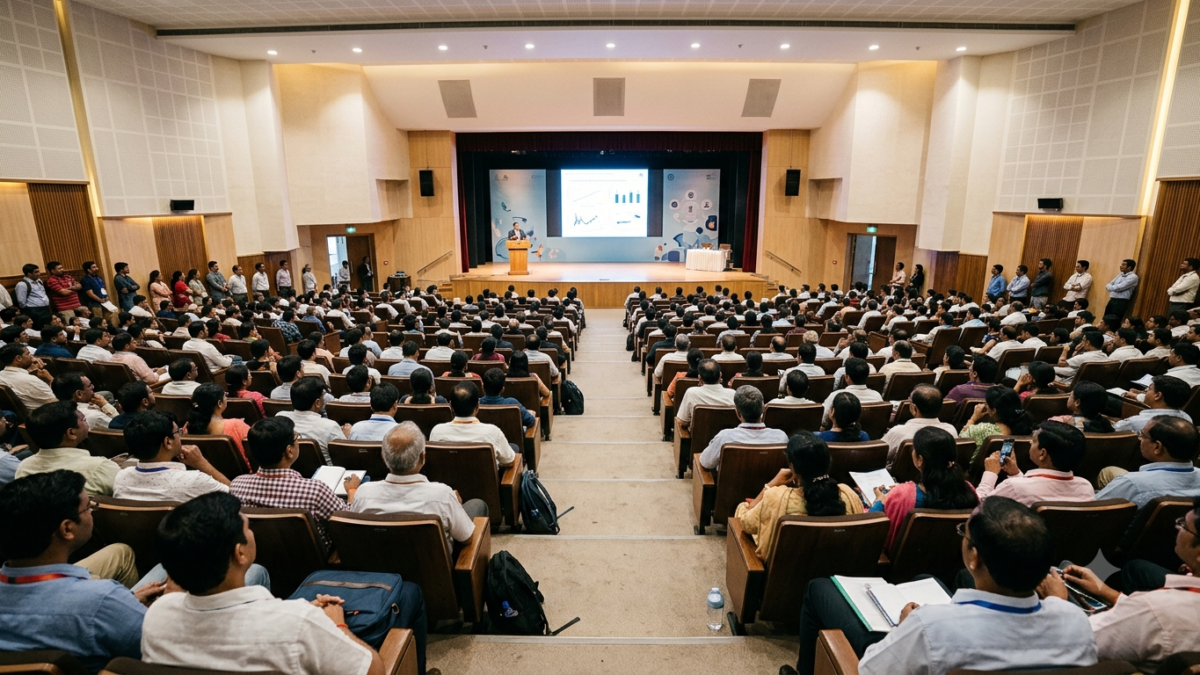
The Indian Academy of Sciences held its 91st Annual Meeting at IISER Tirupati from November 14 to 16, 2025. The three-day event drew many of the country’s leading scientists to the temple city. Because Fellows, Associates and researchers gathered at the Yerpedu campus, Tirupati briefly became a national science stage.
This recap covers what actually happened at the meeting. It names who spoke, which themes led the sessions, and how school students took part. So treat the details below as a record of the event, not a preview.
Tirupati Official is an independent city news guide. We are not affiliated with the Indian Academy of Sciences, IISER Tirupati, or any government body. For official records, always check the primary sources linked below.
The 91st Meeting at a Glance
- Event: 91st Annual Meeting of the Indian Academy of Sciences.
- Dates: November 14 to 16, 2025 (three days).
- Venue: IISER Tirupati Coliseum, Yerpedu, Tirupati district.
- Host: IISER Tirupati, with SVU, IIT Tirupati and NARL.
- President: Professor Raghavan Varadarajan, IISc Bengaluru.
- Access: All sessions were livestreamed on the Academy’s YouTube channel.
What Happened at the Indian Academy of Sciences Meeting
The Indian Academy of Sciences chose Tirupati as its host city for 2025. So the three-day meeting ran at the IISER Tirupati Coliseum from November 14. IISER Tirupati organised the event, while three partners shared the load.
Those partners were Sri Venkateswara University, IIT Tirupati and the National Atmospheric Research Laboratory. Together, they handled the venue and logistics for scientists arriving from across India. Because the coordination was shared, the campus could host a large national gathering smoothly.
The programme opened with a welcome and the introduction of newly elected Fellows and Associates. After that formal start, the sessions moved quickly into research talks and public lectures. The meeting then closed on Sunday, November 16, after three full days.
This was a notable moment for the region, since a science gathering of this scale rarely lands in Tirupati. The city is far better known for pilgrimage, yet it now hosts two major research institutions. That contrast became a recurring theme across the three days.
About the Indian Academy of Sciences
The Indian Academy of Sciences is one of India’s oldest scientific bodies. Physicist and Nobel laureate C.V. Raman founded it in 1934. He registered the body as a society that April, and he became its first president.
The Academy began with 65 founding Fellows, and it is based in Bengaluru today. Its core aim is to promote research in pure and applied science. It also works to carry science to students and the wider public.
Beyond its journals, the Academy runs programmes that reach teachers and young learners directly. For example, it holds refresher courses for teachers and awards summer research fellowships to students. It also organises lecture programmes at schools and universities across the country.
The annual meeting is a fixture of the research calendar, because it lets Fellows present new work. Each year a different institution hosts the gathering, so the venue rotates. In 2024 the meeting was held at Bhubaneswar, while in 2025 the honour went to IISER Tirupati.
Who Led the Sessions
Professor Raghavan Varadarajan led the meeting as President of the Indian Academy of Sciences. His term runs from 2025 to 2027. He also works as a professor at the Indian Institute of Science (IISc), Bengaluru.
His research focuses on protein stability and vaccine design. So during the inaugural session, he spoke on improving the stability and efficacy of viral vaccines. The talk set a serious research tone for the days that followed.
The public lectures then widened the scope beyond the laboratory. Dr Shivkumar Kalyanaraman spoke on the growing role of AI in science and engineering. He is Chief Executive Officer of the Anusandhan National Research Foundation (ANRF).
His lecture drew a direct line between artificial intelligence and everyday research. Because AI now touches nearly every field, the topic held wide appeal. It showed how central the technology has become to Indian science.
Recognising New Fellows and Associates
The opening session did more than start the schedule. It also introduced the Academy’s newly elected Fellows and Associates, which is a yearly tradition at the meeting. Because election as a Fellow recognises sustained research contributions, the honour carries real weight.
Associates, by contrast, are younger researchers whom the Academy supports early in their careers. So the meeting deliberately links established scientists with rising talent. This handover of experience is a quiet but important part of every annual gathering. It also gave attendees in Tirupati a sense of where Indian science is heading next.
Themes That Dominated the Programme
Across the three days, the talks spanned a broad sweep of modern science. Speakers addressed vaccine development, sustainability and climate studies, and astrophysics. Others covered artificial intelligence, space science and evolutionary ecology.
Because the sessions were multidisciplinary, ideas crossed easily between fields. A biologist could sit in on a talk about cosmic phenomena, while a physicist could follow a discussion on ecology. That mix is the whole point of the annual meeting.
The format pulls specialists out of their silos, so ideas travel between fields that rarely meet. Panel discussions and symposia also gave researchers room to debate open questions. They did not only present finished results.
Why the Indian Academy of Sciences Chose Tirupati
Tirupati works as a host because it now carries real research weight. So the Indian Academy of Sciences leaned on that strength when it picked IISER Tirupati. The city is home to both IISER Tirupati and Sri Venkateswara University.
It also sits close to IIT Tirupati and the National Atmospheric Research Laboratory. Because these institutions cluster together, the area has become a genuine research corridor. That density made Tirupati a practical choice for a national meeting.
IISER Tirupati has grown fast since it was established in 2015. Its permanent campus at Yerpedu began operating in 2024, and the institute has built up laboratories and faculty. Since then, its student strength has risen steadily too.
In 2026 it announced a Tri-Institutional Global Innovation Campus, so its ambitions have widened further. The plan involves IIT Tirupati and Canada’s Dalhousie University. Hosting a national meeting fit that path neatly.
The choice also spoke to Tirupati’s changing identity. The city’s growth as an urban and educational centre has been steady, a shift visible in its population and infrastructure trends. So a conclave of this stature confirmed that Tirupati is no longer defined by pilgrimage alone.
Vignana Kathalu: Science for School Students
The meeting was not limited to Fellows and researchers. Alongside the main sessions, IISER Tirupati ran a programme called “Vignana Kathalu.” This two-day outreach ran on November 14 and 15 for school students around Tirupati.
The name translates loosely as “science stories,” and the sessions aimed to make research feel approachable. Students took part in hands-on demonstrations, experimental workshops and talks with scientists. Because the activities were practical, children could try experiments instead of only watching.
Organisers designed the programme to spark early curiosity, so more students might consider research careers. This kind of outreach fits the Academy’s long tradition of school lecture programmes. It also gave local children rare access to working scientists.
How to Watch the Recorded Sessions
If you missed the meeting, the talks are not lost. The Academy livestreamed all sessions on its official YouTube channel during the three days. Those recordings remain available afterward.
This matters for anyone who could not travel to Tirupati, since they can still follow the lectures on demand. For the authoritative programme, use the primary source. The Indian Academy of Sciences annual meetings page carries the official record, while the IISER Tirupati website posts institutional updates.
Event Details
| Detail | Information |
|---|---|
| Meeting | 91st Annual Meeting, Indian Academy of Sciences |
| Dates | November 14 to 16, 2025 |
| Venue | IISER Tirupati Coliseum, Yerpedu |
| Host institute | IISER Tirupati |
| Collaborators | SVU, IIT Tirupati, NARL |
| Academy President | Professor Raghavan Varadarajan (IISc) |
| IISER Director | Professor Santanu Bhattacharya |
| Livestream | Academy YouTube channel |
The Closing Ceremony and Its Significance
The meeting ended on a warm note. At the closing ceremony, Academy President Raghavan Varadarajan presented a memento to Inderpreet Singh Kohli. Kohli is the IISER Tirupati Registrar, and he received it on the institute’s behalf.
He spoke for Director Professor Santanu Bhattacharya, and he thanked the Academy for choosing IISER Tirupati. Kohli also pointed to the timing, since a major CII investment summit was underway in Andhra Pradesh. So he framed the event as a meeting point of science, industry and innovation.
That framing captured why hosting matters beyond the campus, because it puts Tirupati on the national research map. For a city long tied to spirituality, the meeting marked a quiet shift. Tirupati welcomed hundreds of scientists the same week it welcomes pilgrims, and it managed both roles at once.
What This Meeting Means for Tirupati
Three points stand out from the 2025 gathering. First, the venue signalled how far IISER Tirupati has come in a single decade. A ten-year-old institute hosting a national academy meeting is no small feat.
Second, the outreach reached beyond scientists to local schoolchildren, which is rare for a research conclave. Third, the programme balanced deep research with public lectures on AI and vaccines. Because those topics matter far outside the lab, the meeting spoke to a wide audience.
For local students, the benefits are practical rather than abstract. Because these institutes now host national events, students gain exposure they once had to travel for. The recorded talks also stay online, so learning does not stop when the meeting ends.
Taken together, these features made the meeting more than a routine calendar entry. It served as a marker of Andhra Pradesh’s growing role in Indian science. It also gave Tirupati a fresh claim to national attention.
Before You Go
The 91st Annual Meeting of the Indian Academy of Sciences left IISER Tirupati with new connections. It also gave the institute a stronger national profile. Because the conclave mixed frontier research with student outreach, it served both specialists and beginners.
If you want to revisit the talks, the Academy’s YouTube recordings and official pages are the best starting points. For readers tracking Tirupati’s rise as an education hub, this meeting is a clear signal of where the city is heading. It also set a benchmark that future host cities will want to match.
Frequently Asked Questions
When and where was the Indian Academy of Sciences 91st Annual Meeting held?
The 91st Annual Meeting ran from November 14 to 16, 2025. The venue was the IISER Tirupati Coliseum in Yerpedu, Tirupati district. IISER Tirupati hosted it with Sri Venkateswara University, IIT Tirupati and NARL.
Who is the President of the Indian Academy of Sciences?
Professor Raghavan Varadarajan is the President for the 2025 to 2027 term. He is a professor at the Indian Institute of Science, Bengaluru, and he led the Tirupati meeting.
Who founded the Indian Academy of Sciences?
Physicist and Nobel laureate C.V. Raman founded the Academy in 1934. He registered it as a society that April and served as its first president. It began with 65 founding Fellows and is based in Bengaluru.
What topics did the Indian Academy of Sciences cover in 2025?
The sessions spanned vaccine development, sustainability, climate studies and astrophysics. They also covered artificial intelligence, space science and evolutionary ecology. Public lectures addressed AI for science and advances in viral vaccines.
Was the Indian Academy of Sciences meeting open to students?
Yes. A two-day outreach programme called “Vignana Kathalu” ran on November 14 and 15 for local school students. It featured hands-on demonstrations, workshops and interactions with scientists.
Can I watch the sessions online?
Yes. The Academy livestreamed all sessions on its official YouTube channel, and recordings remain available afterward. So students who could not attend can still follow the lectures on demand.
Why was Tirupati chosen to host the meeting?
Tirupati has become a growing research centre, because several major institutes sit nearby. These include IISER Tirupati, Sri Venkateswara University, IIT Tirupati and NARL. IISER Tirupati’s rapid growth since 2015 made it a fitting host.