
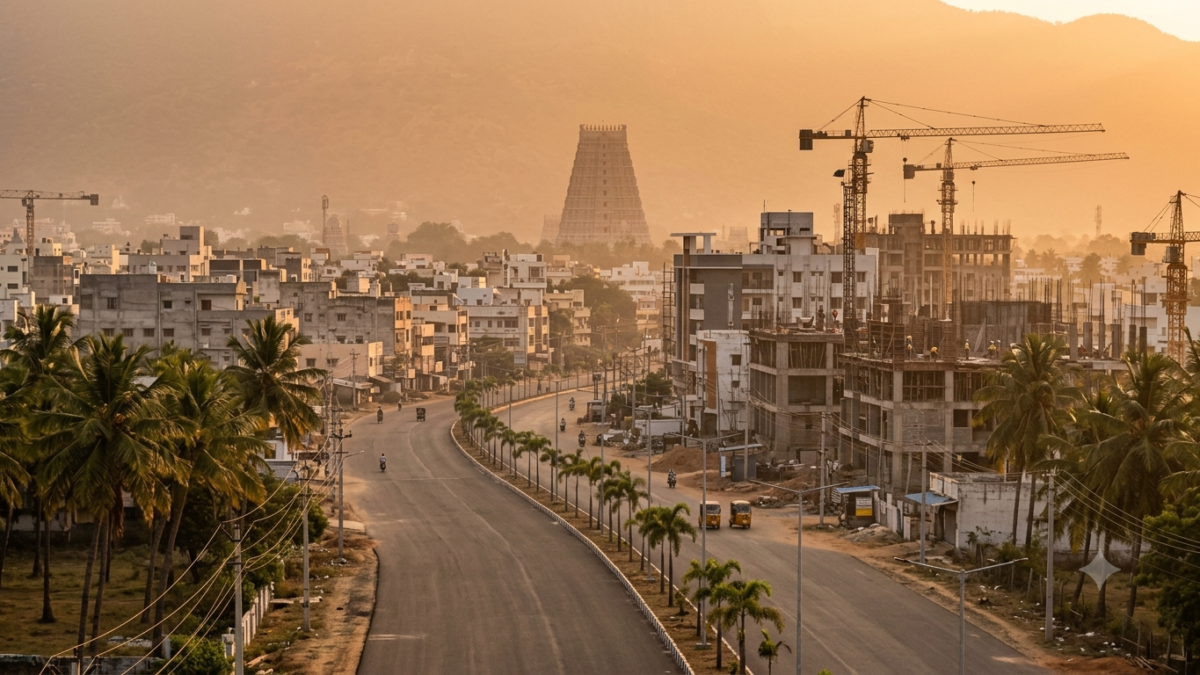
The Tirupati growth engine is shifting into a higher gear, and the district administration says the momentum now reaches residents, local businesses, and the millions of pilgrims who pass through every year. District Collector Dr S. Venkateswar has repeatedly framed the temple city as a rising economic hub, not just a spiritual destination.
So what is actually driving this shift, and what does it mean for people living, working, or visiting here? This guide pulls together the verified numbers behind the claim and explains the parts a short news report usually skips.
Tirupati Official is an independent news guide. It is not a government website, not affiliated with the Tirupati district administration or the Tirumala Tirupati Devasthanams (TTD), and does not issue notices or approvals. Confirm any official announcement on the district portal at tirupati.ap.gov.in.
Tirupati Growth Engine at a Glance
- Industries generate roughly 45% of the district’s revenue, against a state average near 18%.
- Collector Dr S. Venkateswar names industries, tourism, and MSMEs as the three main drivers.
- Around 8,900 homestays have opened in Tirupati city in four years, running near 65% occupancy.
- The district has geo-tagged about 36,000 acres, with roughly 7,000 acres ready for new industry.
- Major hubs already anchor the region: Sri City, KRIS City, EMC clusters, and Naidupeta Industrial Park.
What the Collector Actually Said
At the Confederation of Indian Industry (CII) Tirupati Zone annual meeting in February 2026, Dr Venkateswar described the district as a key economic hub for the Rayalaseema region. He also pointed to the Naidupeta Industrial Park as one of the most in-demand industrial locations in Andhra Pradesh. Because land allotments there are moving quickly, he argued, the district’s industrial base keeps widening.
Earlier, in a vision-plan interview, the Collector summed up his strategy in a single line. The plan focuses on “industries, tourism and MSMEs as major engines for economic growth,” he said. That framing is the real reason the Tirupati growth engine tag has stuck, since it rests on three pillars rather than one.
He also placed the district inside a bigger picture. The Nellore–Tirupati–Chennai triangle has seen rapid industrial expansion over the past 15 to 20 years. Chief Minister N. Chandrababu Naidu has spoken of turning this belt into a major industrial engine for the country within the next decade.
Industries Power the Tirupati Growth Engine
Industry is the loudest driver here, and the numbers explain why. Nearly 45% of the district’s revenue comes from industry, while the state average sits closer to 18%. So Tirupati already pulls far above its weight before any new project opens.
The base is broad. Sri City, one of India’s leading special economic zones, sits within the district. Alongside it run the EMC electronics clusters, the Visakhapatnam–Chennai Industrial Corridor node, and the newer KRIS City knowledge-and-skills zone. Together they make the district a genuine manufacturing address, not a single-factory town.
Room to grow matters too. Officials have mapped and geo-tagged around 36,000 acres, and about 7,000 acres are ready for new units. Because the current state government has pushed a pro-industry stance, the administration is actively inviting fresh proposals for these parcels through the Andhra Pradesh Industrial Infrastructure Corporation (APIIC).
Talent supply strengthens the case further. Tirupati district hosts IIT Tirupati, IISER Tirupati, Sri Venkateswara University, and the National Sanskrit University, among other institutions. Because employers value a ready pool of graduates, this education base makes the district more attractive to industry. So the classrooms feeding the workforce are as much a part of the story as the factories hiring from them.
Space City and the Next Wave
The pipeline reaches into high-tech territory as well. A proposed Space City in the district aims to host satellite manufacturing, drawing on nearby infrastructure and the Satish Dhawan Space Centre at Sriharikota. Although the project is still taking shape, it signals where officials want the Tirupati growth engine to head next.
Tourism Feeds the Tirupati Growth Engine
Faith brings the crowds, and tourism converts them into local income. Tirumala draws pilgrims in the millions every year, so the administration wants each visit to spend a little longer on the ground. Plans encourage devotees to extend their stay by two to three days and explore beyond the hill shrine.
The hospitality build-out shows the effect. Around 8,900 homestays have come up in Tirupati city over four years, running at roughly 65% occupancy. Meanwhile, branded hotels including Novotel-Ibis, Courtyard by Marriott, and Lemon Tree Premier are expected to add rooms to the city’s supply.
Officials are also chasing new visitor categories. Tirupati is being positioned as a destination-wedding centre, while discontinued Tirupati–Tirumala sightseeing tours are being revived. If these efforts land, the city earns from travellers who are not only there for darshan.
MSMEs and Startups Widen the Base
Big factories grab headlines, but small enterprises spread the gains. The Collector has consistently named micro, small, and medium enterprises (MSMEs) as the third leg of the plan. This matters because MSMEs employ locally and keep money circulating in the district.
Innovation support is growing alongside them. The Ratan Tata Innovation Hub (RTIH) in Tirupati worked with 118 startups within its first year, and 28 signed formal incubation agreements. Through its outreach network, the hub has connected with hundreds of entrepreneurs, MSMEs, self-help groups, and colleges across the region.
Collector Venkateswar has praised the hub for building an entrepreneurship ecosystem where rural innovators get a real shot. Because this layer sits beneath the marquee projects, it rarely makes the news, yet it is where much of the district’s job creation actually happens.
Infrastructure Behind the Tirupati Growth Engine
None of these pillars work without roads, water, and civic capacity. So infrastructure spending is quietly central to the whole story. The Tirupati Urban Development Authority has pressed for more central funding for the city’s infrastructure, since fast urban growth strains existing services.
City limits are expanding as well. The proposed Greater Tirupati plan would widen municipal boundaries and reshape how wards are drawn, as covered in our Tirupati Municipal Corporation wards guide. When boundaries grow, so do the demands on drainage, transport, and housing approvals.
Property activity tracks all of this closely. As layouts get approved and registrations rise, more residents formalise ownership, and our walkthrough on online home registration in Tirupati shows how that process now works. Although paperwork is rarely exciting, it is a real signal that the local economy is deepening.
What the Numbers Target Next
The district is not treating growth as a vague ambition. At the 2025 Independence Day event, officials set a growth target near 16.69% for the district. They also projected the district’s per-capita income rising to about ₹6,01,297 by 2028–29 if the vision plans stay on track.
Human development runs in parallel. Under the state’s P4 initiative, thousands of mentor families have “adopted” identified vulnerable households to help lift them out of poverty. So the plan pairs factory-and-hotel growth with a direct push on household incomes.
Tirupati Growth Engine: What It Means for You
Headlines are one thing; daily life is another. Here is the practical read for the three groups the Collector keeps naming.
For residents and job-seekers
More units on those 7,000 ready acres should mean more hiring, especially in manufacturing, hospitality, and MSME roles. Skilling centres like KRIS City and RTIH aim to feed that demand. Still, availability depends on which proposals actually break ground, so treat announced jobs as pipeline, not paycheque.
For local businesses
A longer pilgrim stay is a direct revenue lever for hotels, eateries, transport operators, and guides. If the extend-your-stay push works, footfall spreads across more days and more neighbourhoods. Businesses near new industrial parks may also see steady institutional demand.
For pilgrims and visitors
More rooms and homestays can ease the crunch during peak seasons, although demand around major festivals still outstrips supply. Book official TTD accommodation through the genuine portal at tirumala.org only. Because fake booking sites circulate widely, never pay a private “agent” claiming guaranteed rooms. When in doubt, cross-check the web address against the official TTD portal before you enter any payment or personal details.
Growth Pillars and Key Numbers
| Pillar | Key figure | Why it matters |
|---|---|---|
| Industry | ~45% of district revenue | Far above the ~18% state average |
| Industrial land | ~7,000 acres ready | Room for new units and jobs |
| Tourism | ~8,900 homestays, ~65% full | Pilgrim stay converts to local income |
| Innovation | 118 startups via RTIH | Local entrepreneurship and MSME growth |
| Income target | ~₹6,01,297 by 2028–29 | Per-capita goal in district vision plan |
Read these figures as direction, not guarantee. Growth targets and per-capita projections are planning numbers, so actual results shift with investment, policy, and demand.
What to Watch Before You Believe the Hype
Every growth story has a gap between plan and delivery, and this one is no different. A few honest checks help you read the next announcement clearly.
- Ground-breaking vs signing: land allotments and MoUs are not the same as running factories. Watch for construction and hiring, not just ceremonies.
- Occupancy vs supply: new hotels help only if pilgrim stay actually lengthens. Track whether the extend-stay tours truly restart.
- Per-capita math: a district-wide average can rise while many households see little change. Always ask who the growth reaches.
None of this cancels the progress. Instead, it keeps expectations honest, which is exactly what a careful reader wants.
Before You Go
The Tirupati growth engine is real, measurable, and broader than most people assume. Industry carries the load today, while tourism turns faith into local income, and a quiet MSME-and-startup layer spreads the gains. For now, treat the targets as a serious plan backed by hard numbers, even as you watch delivery on the ground. If you live, run a business, or travel here, the smart move is to follow which projects actually open, then act on results rather than announcements.
Frequently Asked Questions
Who said Tirupati is a growth engine for Andhra Pradesh?
District Collector Dr S. Venkateswar has described Tirupati as a key economic hub for the Rayalaseema region and a rising growth centre in Andhra Pradesh. He has made this case at industry forums, including a CII Tirupati Zone meeting, and in a vision-plan interview. Notably, he names industries, tourism, and MSMEs as the main drivers.
What drives the Tirupati growth engine?
Three pillars drive it: industry, tourism, and MSMEs. Industry alone contributes close to 45% of district revenue, which is well above the state average. Tourism converts pilgrim footfall into local spending, while MSMEs and startups spread employment across the district.
How much industrial land is available in Tirupati district?
Officials have geo-tagged around 36,000 acres, with roughly 7,000 acres ready for new industrial projects. The administration is currently inviting fresh proposals for these parcels. Availability and terms should be confirmed with APIIC before you rely on them.
Is Tirupati only about temple tourism?
No. Tirumala pilgrimage remains central, yet the district is also a major industrial base with special economic zones like Sri City. The plan deliberately blends spiritual tourism with manufacturing, MSMEs, and emerging sectors such as space technology.
Will the growth create jobs for local residents?
That is the stated goal, especially in manufacturing, hospitality, and MSME roles. Skilling hubs like KRIS City and RTIH aim to prepare local talent. However, actual hiring depends on which announced projects reach construction and operation.
What is the district’s per-capita income target?
Officials projected per-capita income rising to about ₹6,01,297 by 2028–29 under the district vision plan, alongside a growth target near 16.69%. These are planning figures. Real outcomes will depend on investment and delivery over the coming years.
How can pilgrims benefit from Tirupati’s growth?
More hotels and homestays can ease room shortages outside peak periods, while revived sightseeing tours add things to do beyond darshan. Always book TTD services through the official portal. Avoid private agents or unofficial sites promising guaranteed accommodation.