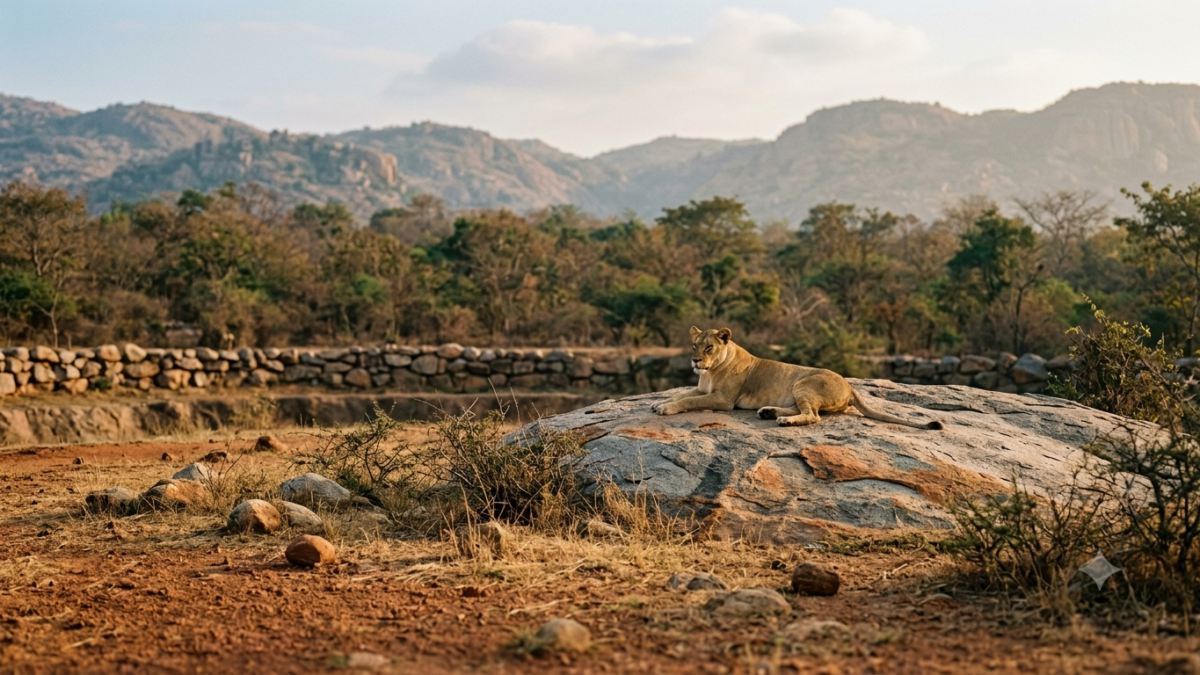
The Lioness Indhu Tirupati Zoo story ended on Tuesday, 26 August 2025. The 23-year-old big cat died of age-related illness at Sri Venkateswara Zoological Park. She had arrived in 2002 as an eight-month-old cub seized from a circus, so the park was the only home she really knew.
Her age alone made the death notable, because captive lionesses rarely pass twenty. This report sets out what officials actually confirmed. It also corrects several details that circulated widely at the time.
Lioness Indhu Tirupati Zoo: Key Facts at a Glance
- Who: Indhu, a female Asiatic-lineage lion housed at Sri Venkateswara Zoological Park (SVZP), Tirupati.
- Age at death: 23 years, well beyond the usual captive span of 16 to 20 years.
- Date of death: Tuesday morning, 26 August 2025.
- Cause: natural, age-related causes, confirmed by post-mortem.
- Origin: rescued from the Thane National Circus in 2002 at roughly eight months old.
- Post-mortem: conducted by specialists from Sri Venkateswara Veterinary University.
Tirupati Official is an independent city news publication. We are not affiliated with, endorsed by, or the official website of Sri Venkateswara Zoological Park, the Andhra Pradesh Forest Department, the Central Zoo Authority, or Tirumala Tirupati Devasthanams. We do not sell zoo tickets and we take no bookings. For entry fees, timings and safari tickets, use the park’s own website.
Lioness Indhu Tirupati Zoo: What Officials Confirmed
The Lioness Indhu Tirupati Zoo announcement came from the park itself, so the core facts have never been in dispute. What follows is the official account, stripped of the embellishment that crept into later coverage.
Park officials said Indhu had been under intensive veterinary supervision for several weeks before she died. Her decline was geriatric rather than sudden, so keepers had been managing her comfort rather than treating a single acute illness. She died on the Tuesday morning despite that care.
A post-mortem examination followed, carried out by experts from Sri Venkateswara Veterinary University. Their finding was straightforward: she died of natural causes linked to ageing. Because the examination was independent of the zoo’s own veterinary team, the conclusion carries more weight than an in-house statement would.
In its public statement, the park framed her life as an illustration of what rescue and rehabilitation can achieve. Officials noted that she had spent more than two decades in a settled environment, and they credited her longevity to sustained care. The zoo also said she had outlived every one of the other lions rescued alongside her. That last detail matters, since it tells you something about how the rest of that rescued cohort fared.
Five Things Early Reports Got Wrong About Lioness Indhu at Tirupati Zoo
Lioness Indhu Tirupati Zoo coverage spread quickly across aggregator sites, and several errors travelled with it. Some of those errors still appear in search results today. Here is what the primary reporting and official records actually show.
The date was 26 August, not 19 August
Several secondary write-ups placed her death a week earlier. Both 19 and 26 August 2025 fell on a Tuesday, which is probably how the confusion started. Contemporaneous reporting filed on the evening of 26 August described the death as having happened that same morning.
She was rescued in 2002, not 2004
The rescue year appears as 2004 on a number of pages. Primary reporting gives 2002, and it names the source: the Thane National Circus in Maharashtra. She was around eight months old when she reached Tirupati.
Lioness Indhu spent 23 years at Tirupati Zoo, not 20
Because the rescue year was widely misreported, her time at the zoo was also understated. From 2002 to 2025 is roughly 23 years, which is nearly her entire life.
Her name is sometimes given as “Sindhu”
At least one national outlet later referred to her as Sindhu while recapping the year’s animal deaths. The Tirupati-datelined reports at the time used Indhu, so that is the spelling used here.
The zoo is not 5,500 acres
This figure appears almost everywhere, including on travel listings and encyclopaedia entries. Most Lioness Indhu Tirupati Zoo write-ups simply repeated it. Official records tell a different story, so the section below sets out the real number.
Lioness Indhu Tirupati Zoo Timeline: From Circus Cub to Park Elder
| Year | What happened |
|---|---|
| 1998 | India bars lions, tigers, bears, monkeys and panthers from circus performance. |
| 2001 | The Supreme Court upholds that ban. |
| 2002 | Indhu arrives at SVZP from Thane National Circus, aged about eight months. |
| 2013 | The performance ban extends to elephants. |
| 2018 | The Central Zoo Authority derecognises the remaining animal circuses. |
| 2025 | Indhu dies on 26 August, aged 23. |
Read straight through, that sequence is really a policy story with an animal at the centre of it. The 1998 notification created a population of displaced big cats almost overnight. Zoos then absorbed them, and Indhu was one of the animals that absorption produced.
Why 23 Years Was Exceptional for a Captive Lioness
Her age is the most quoted fact in every Lioness Indhu Tirupati Zoo report, and it earns that attention. Lionesses in captivity generally live between 16 and 20 years.
Wild lionesses typically manage far less, because injury, territorial conflict and food scarcity all take their toll. Indhu therefore outlived the usual captive ceiling by three years or more.
That gap is not trivial. Circus-rescued animals often arrive with skeletal problems, dental damage, poor muscle development and behavioural stress from years of confinement and travel. Many die well short of their species average as a result. Indhu instead reached an age that most zoo lions never see.
Her arrival age helps explain this. She came in at eight months, which means she spent almost no time in the circus system before rescue. Animals removed as adults after years of performance carry far heavier physical damage, so their outcomes are usually worse.
How Circus Lions Reached Indian Zoos in the First Place
On 14 October 1998, the central government issued a notification under the Prevention of Cruelty to Animals Act, 1960. It barred bears, monkeys, tigers, panthers and lions from being exhibited or trained as performing animals. The Indian Circus Federation challenged it, but the Supreme Court upheld the notification in 2001.
That left circus operators holding animals they could no longer legally use. State forest departments and the Central Zoo Authority then had to place them somewhere, so recognised zoos across the country took them in. Bannerghatta near Bengaluru, Tirupati and several others built or expanded rescue centres for exactly this purpose.
The policy tightened further over time. Elephants were brought under the performance ban in 2013. Then, after a year-long inspection drive, the Central Zoo Authority derecognised the remaining circuses that still used wild animals. Indhu’s whole life at Tirupati sits inside that arc.
The Lioness Indhu Tirupati Zoo Death in Wider Context
The Lioness Indhu Tirupati Zoo loss landed in the middle of a difficult run for the park. Indhu’s death was not an isolated event. Over roughly two years, SVZP lost a string of big cats, and officials attributed most of those deaths to age or chronic illness.
In December 2023, a 23-year-old lioness named Sita died, and a male lion named Anurag followed shortly afterwards. Anurag had congenital health problems, and the curator at the time linked them publicly to inbreeding within zoo populations. In March 2024, a seven-year-old lioness died after surgery for pelvic tumours. A lion named Vikram died at eleven.
Then, less than two months after Indhu, the park lost Sameer, a white tiger who had been brought from Hyderabad’s Nehru Zoological Park in 2010. He died on 19 October 2025 at nineteen, after kidney failure and chronic illness. He had already been withdrawn from public view for about a year.
Clustered deaths of this kind look alarming, yet the pattern has a demographic explanation. Rescue-centre animals arrive in cohorts, so they age in cohorts too. A group of lions that arrives together also tends to die together.
What the Official Records Say About the Zoo
The official park website and Central Zoo Authority records both put the area at 1,254.71 hectares. Roughly 289 hectares of that has been developed so far. That works out to about 3,100 acres in total, not the 5,532-acre figure repeated on travel listings and reference sites.
The confusion is worth correcting because the number gets quoted constantly. Official sources give the area in hectares, and somewhere along the line a different acreage entered circulation. If you are citing the park’s size, use 1,254.71 hectares.
Other verified basics are simpler. The foundation stone was laid on 29 September 1987, although the park opened to the public only on 30 April 1993. It sits in Tirupati Reserve Forest Extension, at the foot of the Seshachalam hills. Official records describe it as the largest zoological park in Asia by area.
Recent collection records list 31 mammal species, 46 bird species and 7 reptile species. The developed area therefore holds a fairly compact collection inside a very large forest holding.
What Visitors See at the Park Today
Readers who reach this page searching for Lioness Indhu Tirupati Zoo details usually want to know what remains there now.
Indhu’s enclosure no longer forms part of the visitor route, so anyone arriving specifically to see her should know that in advance. The lion safari continues to operate, and lions remain among the park’s main draws.
Not every rescued animal is on display in the first place. Zoos routinely keep elderly or fragile rescue-centre animals away from public viewing. That happens partly for the animal’s sake, and partly because visitors react badly to a frail big cat. Sameer, for instance, had been off view for around a year before he died.
The park has also been adding species. In August 2025, the same month Indhu died, it introduced breeding pairs of red-necked wallabies, meerkats and common marmosets. Entry fees, safari charges and opening hours change from time to time. So confirm current rates on the park’s official website before you travel.
A safety note: barriers at the park exist for good reason. In February 2024, a visitor who climbed into a lion enclosure was killed. Stay behind fences, keep children within reach, and follow keeper instructions inside the safari zone.
What the Lioness Indhu Tirupati Zoo Story Says About Rescue Policy
India’s circus ban is often described as a finished piece of work. Indhu’s life suggests it was really the beginning of a much longer obligation. Rescuing one animal from a circus commits a zoo to two decades or more of care.
That obligation is now reaching its natural end. The animals seized after 1998 have either died or entered advanced old age. So the wave of geriatric deaths at rescue-heavy zoos will run for a few more years yet. Reading each death as a scandal misses this.
There is a fair criticism buried in the record, though. When a curator publicly ties congenital defects to inbreeding in zoo populations, that is a management question rather than an ageing question. Genetic diversity in captive big-cat populations deserves the scrutiny that individual deaths tend to attract. Anyone following civic and environmental news in Tirupati will recognise the pattern, since the Seshachalam fringe faces similar pressure from the city’s rapid population growth.
Before You Go
Indhu died on 26 August 2025, aged 23, of natural age-related causes confirmed by post-mortem. She was rescued from the Thane National Circus in 2002 as a cub, and she spent 23 years at Sri Venkateswara Zoological Park. Those are the Lioness Indhu Tirupati Zoo facts worth carrying away, because almost every error circulating online involves one of them.
If you plan to visit the park, treat online figures for fees, timings and area with caution and check the official site first. The wider Seshachalam landscape is worth exploring too, including the waterfalls inside Sri Venkateswara National Park.
Lioness Indhu Tirupati Zoo: Common Questions Answered
When exactly did Lioness Indhu of Tirupati Zoo die?
She died on the morning of Tuesday, 26 August 2025, at Sri Venkateswara Zoological Park in Tirupati. Reporting filed that evening described the death as having occurred that morning. Pages giving 19 August are incorrect, although the confusion is understandable because that date was also a Tuesday.
How old was Lioness Indhu at Tirupati Zoo when she died?
She was 23. Captive lionesses generally live 16 to 20 years, so she outlived the usual span by a clear margin. Her age was the main reason her death drew coverage beyond Tirupati.
Which circus was she rescued from?
She came from the Thane National Circus in Maharashtra in 2002, when she was about eight months old. Widely copied claims that she was rescued in 2004 do not match the primary reporting from Tirupati.
What caused her death?
Natural, age-related causes. A post-mortem by experts from Sri Venkateswara Veterinary University confirmed this. Park officials said she had been under intensive veterinary care for several weeks as geriatric complications set in.
Why were circus lions sent to zoos in India?
A notification dated 14 October 1998 banned lions, tigers, bears, monkeys and panthers from performing, and the Supreme Court upheld it in 2001. Circuses could no longer keep those animals legally, so forest departments and the Central Zoo Authority placed them in recognised zoos and rescue centres.
Have other big cats died at the park recently?
Yes. Sita, a 23-year-old lioness, and Anurag, a male lion, both died in December 2023. A seven-year-old lioness died in March 2024, and a lion named Vikram died at eleven. Sameer, a 19-year-old white tiger, died on 19 October 2025.
How large is Sri Venkateswara Zoological Park really?
Official records give 1,254.71 hectares, or roughly 3,100 acres, with about 289 hectares developed. The 5,532-acre figure that appears on many websites does not match the park’s own published area.
Can visitors still see lions at the park?
Yes. The lion safari continues to run and lions remain a headline attraction, although individual animals move in and out of public view depending on their health. Check current safari timings and ticket rates on the official park website before visiting.