The markets in Tirupati sit barely ten minutes from the railway station, yet most visitors never walk into one. Pilgrims move from the station to the Tirumala bus queue and back again. Locals, meanwhile, do their real buying on Gandhi Road, inside the Rythu Bazaar and along the lanes behind Bazaar Street.
This guide maps each of those markets in Tirupati with honest price bands, crowd timings and travel notes. It also names the one shopping mistake that costs devotees the most money, because almost every other city guide repeats it.
Independence notice: Tirupati Official is an independent city guide. We are not affiliated with, endorsed by, or the official website of Tirumala Tirupati Devasthanams, Tirupati Municipal Corporation, or any shop or trader named here. We take no bookings, orders, or payments. Use the official portals linked below for anything official.
Markets in Tirupati at a Glance
Here is the short version of the markets in Tirupati, so you can plan before leaving your hotel.
- Gandhi Road is the main retail spine, so expect clothing, footwear, electronics and general goods.
- Bazaar Street, near Sri Govindaraja Swamy Temple, is the puja-item and souvenir belt.
- Rythu Bazaar is the Andhra Pradesh government farmers’ market for vegetables and fruit.
- Lepakshi and APCO showrooms sell government-certified handicrafts and handloom sarees.
- Genuine Tirumala laddu is never sold in any city shop, so ignore every stall that offers it.
- Most shops open around 10 am and trade until roughly 9 pm, while vegetable markets start at dawn.
Timings vary by trader and by season. Because small shops keep their own hours, treat every figure here as indicative rather than fixed.
Gandhi Road: The Busiest of the Markets in Tirupati
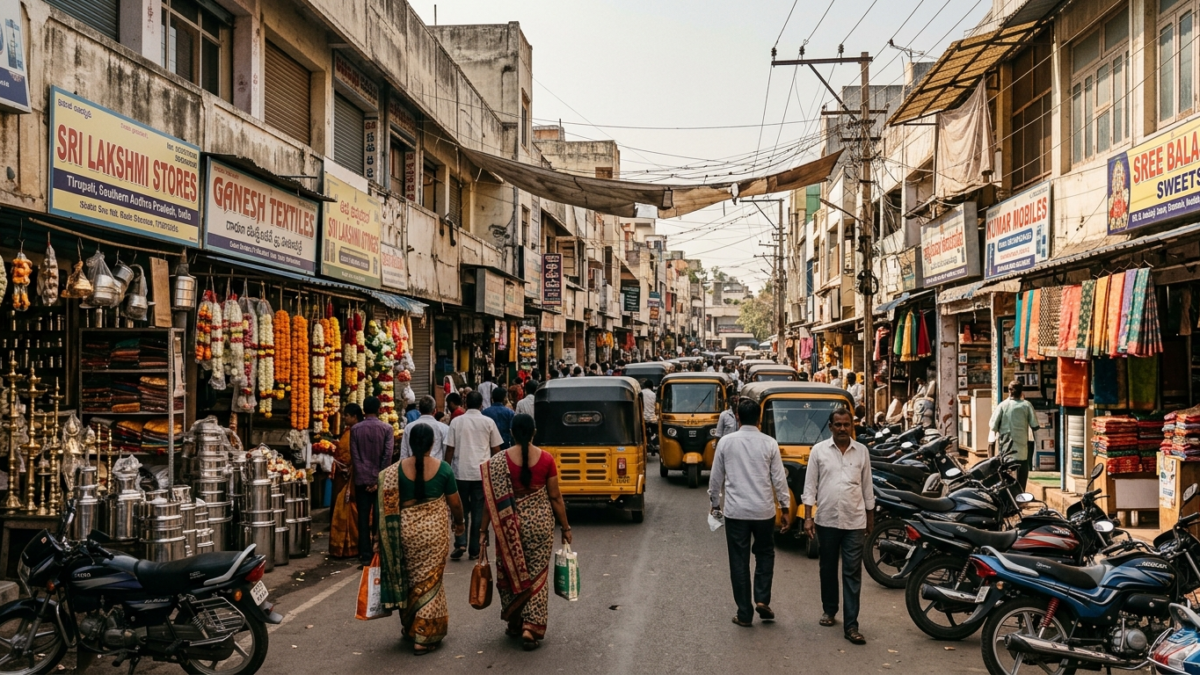
Gandhi Road runs through the commercial heart of the city. It carries the highest footfall of all the markets in Tirupati, so it is also the noisiest. Textile showrooms, bangle stalls, footwear shops and general stores line both sides.
The road connects onward to TK Street and Nehru Street, and these three together form one continuous shopping stretch. You can walk the whole length in about twenty minutes if the crowd is thin. On festival weekends that same walk takes twice as long.
Ready-made clothing and school uniforms dominate the middle section. Household goods, steel vessels and toys cluster nearer the junctions. Because rents differ sharply between the main road and the side lanes, the same item often costs less one street back.
Bazaar Street and the Temple Lanes
Bazaar Street sits close to Sri Govindaraja Swamy Temple, in the older part of town. This is where devotees buy puja articles before or after a temple visit. Brass lamps, camphor, kumkum, framed deity photographs and tulsi malas fill the shopfronts. Among all the markets in Tirupati, this belt serves pilgrims most directly.
Prices here move with the pilgrim season. During Brahmotsavams and long weekends, traders quote higher, since demand spikes and stock moves fast. Visit on a weekday morning and the same brass lamp is usually cheaper.
Do not confuse this street with the Bazaar Street at Chandragiri. That one lies roughly 12 km west of the city and is a separate stop altogether. Several travel blogs merge the two, which sends readers on a pointless detour.
Rythu Bazaar: Where Tirupati Actually Buys Vegetables
Rythu Bazaar is a state-run farmers’ market, not a private shop. The Government of Andhra Pradesh launched the scheme in 1999 so that growers could sell straight to households. No market fee or service charge is levied on the farmer.
Tirupati’s main Rythu Bazaar operates near Annamaiah Circle, off RC Road. Prices are fixed by a committee of farmers and a departmental officer, so they usually land below normal city retail rates. That pricing rule is the reason residents cross town for it.
Arrive between 6 am and 9 am for the best stock. Leafy greens and country vegetables sell out first, while onions and potatoes last through the day. Carry your own cloth bag, because plastic carry bags are restricted in municipal market areas.
The state has also been piloting digital ordering and home delivery from selected Rythu Bazaars, with Tirupati among the listed cities. Coverage is still limited, so confirm availability locally before you rely on it.
What to Buy and Where: A Quick Comparison
The markets in Tirupati suit very different shopping lists. Use this table to decide where to spend your limited time.
| Market | Best for | Typical hours | Price level |
|---|---|---|---|
| Gandhi Road | Clothing, footwear, general goods | Around 10 am to 9 pm | Mid-range, negotiable |
| Bazaar Street | Puja items, souvenirs, brassware | Around 8 am to 9 pm | Varies with season |
| Rythu Bazaar | Vegetables, fruit, greens | Early morning onward | Below city retail |
| Lepakshi and APCO | Handicrafts, handloom sarees | Standard showroom hours | Fixed, no bargaining |
Figures above are indicative and change without notice. Confirm hours locally on the day you plan to shop.
The Laddu Warning Every Shopper Needs
This is the costliest mistake made in the markets in Tirupati, and it is entirely avoidable. Genuine Srivari laddu is prepared only in the Potu kitchen at Tirumala. Tirumala Tirupati Devasthanams sells it through its own counters on the hill, and nowhere else in the city.
The prasadam carries a Geographical Indication tag granted on 15 September 2009 under the Geographical Indications of Goods Act, 1999. That tag legally restricts the name to laddus made inside the temple under prescribed supervision. TTD has since issued legal notices to vendors and online sellers marketing look-alike products as temple prasadam.
So any shop, stall or website in the city offering “Tirupati laddu” is selling an ordinary besan sweet. It may taste fine, yet it is not consecrated prasadam. Buy your laddu at the TTD counter after darshan instead, and check current counter rates on the official TTD website.
TTD has priced the small laddu at a nominal counter rate for several years, with a larger Kalyanotsavam laddu costing more. Rates do change, so verify them at tirumala.org rather than trusting an old blog figure.
Government Emporiums Beat Souvenir Stalls
Most visitors buy handicrafts from stalls in the markets in Tirupati and assume that is the local craft scene. Andhra Pradesh actually runs two official retail chains for exactly this purpose. Lepakshi Handicrafts is operated by the Andhra Pradesh Handicrafts Development Corporation, while APCO sells handloom fabric through the state weavers’ cooperative.
Lepakshi stocks Kalamkari work, Kondapalli toys, Etikoppaka lacquerware and wood carvings. APCO carries Venkatagiri, Mangalagiri and Uppada weaves. Because both are government undertakings, prices are fixed and the craft origin is documented.
You will pay more than a street stall asks. In return you avoid the machine-printed “Kalamkari” that floods tourist counters. Browse the catalogues at lepakshihandicrafts.gov.in before you visit, so you know what genuine work looks like.
Best Time to Visit Markets in Tirupati
Timing shapes the markets in Tirupati more than any other factor. Vegetable markets peak at dawn, while retail streets only wake up mid-morning. Choose your slot according to what you actually need.
For fresh produce, go between 6 am and 9 am. For clothing and souvenirs, weekday afternoons between 2 pm and 5 pm are calmest. Avoid Saturday evenings entirely, since the whole city shops then.
Season matters too. During Brahmotsavams, Vaikunta Ekadasi and the summer holidays, pilgrim numbers surge and every market tightens. November to February brings pleasant weather, so walking the streets is far easier then.
How to Reach the Main Markets in Tirupati
Almost everything worth visiting sits within a three-kilometre radius of Tirupati railway station. Autos are the practical choice, although drivers rarely use the meter. Agree the fare before you sit down.
Our guide to real auto and taxi fares in Tirupati lists the going rates for common routes. City buses also connect the station, Gandhi Road and the RC Road area at low cost. If you are arriving by train, our Tirupati railway station guide explains the exits and the prepaid stand.
Parking is the real constraint. Gandhi Road has almost no legal roadside parking during business hours, so leave the car at your hotel. Walking between the market clusters is genuinely faster.
What Most Guides Get Wrong About Markets in Tirupati
Aggregator articles about the markets in Tirupati recycle each other, and the errors compound. Three of them mislead readers repeatedly.
First, many lists still name Big Bazaar as a shopping option. That chain wound down its operations across India after its parent company’s insolvency, so the branding you read about no longer reflects what stands there.
Second, several guides describe a single “Poola Market” selling flowers, vegetables and fish together. Flower trade in the city clusters near the temple lanes and the vegetable markets, rather than in one named bazaar. Ask locally for the nearest flower street instead of hunting a landmark that guides invented.
Third, listicles present Chandragiri handloom shopping as a Tirupati market. It is a worthwhile trip, yet it needs its own half day and separate transport.
Bargaining, Safety and Crowd Sense
Bargaining is normal in the street markets in Tirupati and unwelcome in the showrooms. On Gandhi Road and Bazaar Street, an opening quote is usually negotiable by a modest margin. At Lepakshi, APCO, and any billed retail chain, prices are fixed.
Keep your phone and wallet in a front pocket while you move through dense stretches. Pickpocketing risk rises during festival crowds, as it does in every pilgrim city. Municipal grievances about market cleanliness or encroachment go to Tirupati Municipal Corporation through its official portal.
Summer afternoons here get genuinely harsh, and shaded seating is scarce. Carry water, take breaks, and skip midday shopping if you have a heart condition or travel with elderly parents or young children. Anyone feeling faint should sit down and seek medical help rather than push on.
Before You Go
Treat the markets in Tirupati as three separate shopping zones rather than one bazaar. Gandhi Road covers daily retail, Bazaar Street covers devotional items, and Rythu Bazaar covers food. Add a Lepakshi or APCO stop if you want a gift that will outlast the trip.
Buy prasadam only from official TTD counters, verify every price on the day, and shop early. If you have spare time between markets, our roundup of the best parks in Tirupati pairs well with an evening walk.
Frequently Asked Questions
Which is the main market in Tirupati?
Gandhi Road is the main market area, since it carries the largest concentration of retail shops and the heaviest footfall. Bazaar Street near Sri Govindaraja Swamy Temple is the second hub, and it focuses on puja articles and souvenirs. Rythu Bazaar handles the city’s fresh produce trade.
What is Tirupati famous for shopping?
Tirupati is known for puja articles, brass lamps, deity photographs, temple jewellery and handloom sarees. Andhra crafts such as Kalamkari fabric, Kondapalli toys and Etikoppaka lacquerware are sold through government emporiums. Devotional items remain the most bought category, because most visitors arrive as pilgrims.
Can I buy the original Tirupati laddu in the city market?
No. Genuine Srivari laddu is made only at Tirumala and sold only at TTD counters on the hill. The name carries a Geographical Indication tag, so sweets sold under it in city shops are not temple prasadam.
What are the timings of Rythu Bazaar in Tirupati?
Rythu Bazaar opens early, and the strongest stock is available roughly between 6 am and 9 am. Trading continues through the day, although choice narrows considerably by afternoon. Confirm the current schedule locally, since municipal timings occasionally shift.
Is bargaining acceptable in Tirupati markets?
Yes, in street markets and small independent shops. Expect a modest reduction rather than a dramatic one, because margins on devotional goods are already thin. Government emporiums and branded showrooms sell at fixed prices, so bargaining there is pointless.
Are the markets in Tirupati open on Sundays?
Most shops trade seven days a week, since pilgrim traffic never really stops. Sunday evenings are the busiest window of the entire week. Individual traders still take occasional weekly holidays, so a quick phone check saves a wasted trip.
How far are the markets from Tirupati railway station?
Gandhi Road and Bazaar Street lie roughly one to two kilometres from the railway station, which is a short auto ride. The Rythu Bazaar area near RC Road sits a little further out. Walking is realistic for the central cluster if the weather is kind.
Where can I buy authentic Andhra handloom sarees in Tirupati?
APCO showrooms sell handloom weaves certified through the Andhra Pradesh State Handloom Weavers Cooperative Society. Lepakshi outlets carry handicrafts from the state handicrafts corporation. Both operate at fixed prices, so you avoid the powerloom imitations common in tourist stalls.